Showing posts with label Olig2 antibody. Show all posts

Tuesday, April 14, 2015

Markers for Oligodendrocyte Progenitor Cells (OPCs)

Improving OPC Expansion

Researchers reference use of Neuromics' GFAP and PDGF R Alpha/CD140A for OPC Selection

The data provided in this publication demonstrates that the OPC yield from SVZ-derived cell cultures can be improved with the PDGF-BB isoform in comparison to classical bFGF-EGF, or PDGF-AA-based protocols. Additionally, it would be expected that the OPC-enriched cultures obtained from NSC/NPC exposure to PDGF-BB and heparin generate cells suitable for cell transplantation for treating demyelinating diseases: Paula G. Franco, Juana M. Pasquini, Lucas Silvestroff. Optimizing Culture Medium Composition to Improve Oligodendrocyte Progenitor Cell Yields In Vitro from Subventricular Zone-Derived Neural Progenitor Cell Neurospheres. Published: April 2, 2015DOI: 10.1371/journal.pone.0121774:
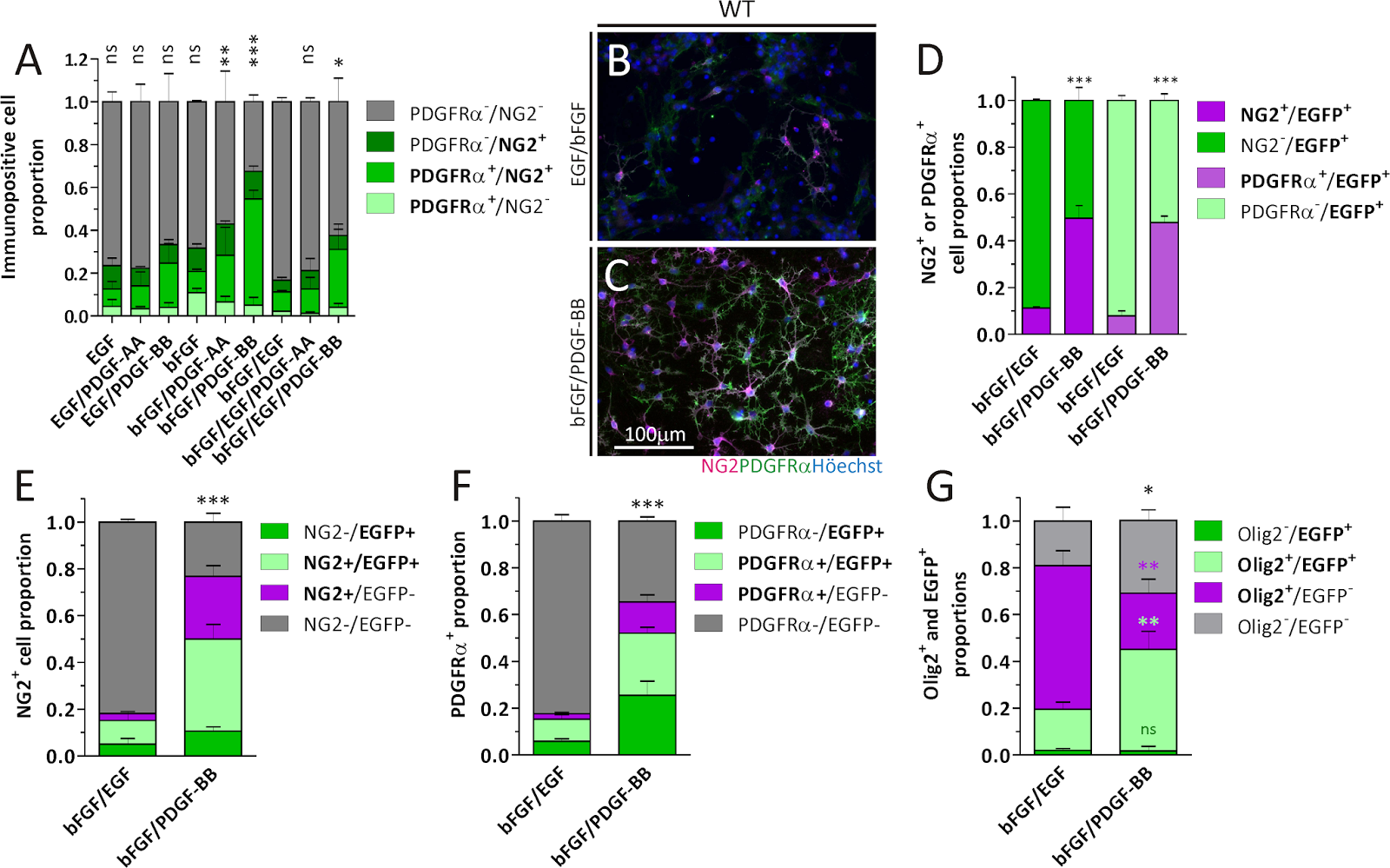
Images: Detection of OPC markers by ICC on NS cells. A) Quantitation of NG2+ and/or PDGFRα+ cell proportions in WT mice NS generated in the presence of different growth factor combinations. Data belong to three independent experiments for each condition. Data for NG2-/PDGFRα- was analyzed with a One-way ANOVA plus Dunnett´s post test, where bFGF/EGF was set as the control. B, C) Representative images of NG2+ and PDGFRα+ cells generated from WT mice cultures in the presence of either bFGF/EGF or bFGF/PDGF-BB. D) Comparison of NG2+ or PDGFRα+ cell proportions in NS cultures generated from Act::EGFP mice in the presence of bFGF/EGF or bFGF/PDGF-BB. Data for NG2+ (dark magenta) or PDGFRα+ (light magenta) cells was analyzed separately with Student´s t test. E, F) NG2 and PDGFRα immunodetection in CNP::EGFP derived cultures. Gray bars in each graph were analyzed with Student´s t test. G) Olig2 expression in WT mice NS cultures. Asterisks are colour coded to indicate the pairs of bars compared and analyzed with Student´s t test. Cell proportions in A, and D-G are expressed as a fraction of the total cell nuclei counted for each condition. Error bars represent the SD for all bar graphs.. doi:10.1371/journal.pone.0121774.g001.

Neuromics has an excellent catalog of Stem Cell Selection Markers.

Monday, October 29, 2012

OPC Markers!

Effective Oligodendrocyte, Oligodendroglial Oligodendrocyte Lineage Markers are important for determining the differentiate state of Oligodendrocyte Precursor Cells. This is important for the study of de and re-myelination of neurons and the discovery of potential therapeutic targets for diseases like MS and ALS.

Here researchers use our Olig2 antibody to study the differentiation state of Fetal Human Oligodendrocyte Progenitor Cells: Crystal R. McClain, Fraser J. Sim and Steven A. Goldman. Pleiotrophin Suppression of Receptor Protein Tyrosine Phosphatase-β/ζ Maintains the Self-Renewal Competence of Fetal Human Oligodendrocyte Progenitor Cells. The Journal of Neuroscience, 24 October 2012, 32(43): 15066-15075; doi: 10.1523/​JNEUROSCI.1320-12.2012.
Abstract: Oligodendrocyte progenitor cells (OPCs) persist in human white matter, yet the mechanisms by which they are maintained in an undifferentiated state are unknown. Human OPCs differentially express protein tyrosine phosphatase receptor β/ζ (PTPRZ1) and its inhibitory ligand, pleiotrophin, suggesting the maintenance of an autocrine loop by which PTPRZ1 activity is tonically suppressed. PTPRZ1 constitutively promotes the tyrosine dephosphorylation of β-catenin and, thus, β-catenin participation in T cell factor (TCF)-mediated transcription. Using CD140a/PDGFRα-based fluorescence-activated cell sorting to isolate fetal OPCs from the fetal brain at gestational ages 16–22 weeks, we asked whether pleiotrophin modulated the expansion of OPCs and, if so, whether this was effected through the serial engagement of PTPRZ1 and β-catenin-dependent signals, such as TCF-mediated transcription. Lentiviral shRNAi knockdown of PTPRZ1 induced TCF-mediated transcription and substantially augmented GSK3β inhibition-induced TCF-reporter luciferase expression, suggesting dual regulation of β-catenin and the importance of PTPRZ1 as a tonic brake upon TCF-dependent transcription. Pharmacological inhibition of GSK3β triggered substrate detachment and initiated sphere formation, yet had no effect on either proliferation or net cell number. In contrast, pleiotrophin strongly potentiated the proliferation of CD140a+-sorted OPCs, as did PTPRZ1 knockdown, which significantly increased the total number of population doublings exhibited by OPCs before mitotic senescence. These observations suggest that pleiotrophin inhibition of PTPRZ1 contributes to the homeostatic self-renewal of OPCs and that this process is mediated by the tonic activation of β-catenin/TCF-dependent transcription.


Images: To verify that GSK3β inhibition was effecting TCF activation through altering localization of β-catenin, the Wnt signaling intermediate, β-catenin, was localized by confocal imaging in OPCs, validated as such by their coexpression of Olig2.

Marker Options:
NameCatalog #TypeSpeciesApplicationsSizePrice
CNPaseCH23013Chicken IgYH; MICC; IHC100 ul$89
Caspr2SP15104Sheep IgGH; MIHC; WB; E100 ug$365
HSP105MO20028Mouse IgGH; M; RIHC; WB100 ul$155
MAG/Siglec 4aGT15152Goat IgGRIHC; WB; E100 ug$365
MOGGT15141Goat IgGHIHC; WB; E100 ug$365
Mash1GT15216Goat IgGMIHC; WB; E100 ug$365
Mash1MO15048Rat IgGH; MICC; WB; E100 ug$255
NOGO ReceptorGT15154Goat IgGHIHC; WB; E100 ug$365
OMgpGT15200Goat IgGHWB; E100 ug$365
Olig1RA14141Rabbit IgGRIHC100 ul
100 ul @ 1mg/ml
$350
$95
Olig1,2,3MO15059Mouse IgGH; RIHC100 ug$305
Olig2GT15132Goat IgGH; MIHC; WB; E100 ug$365
Olig2RA25081Rabbit IgGH; M; RICC; IHC; WB; IP100 ul$395
Oligodendrocyte Marker O1MO15001Mouse IgMH; M; RIHC; FC50 ug$215
Oligodendrocyte Marker O4MO15002Mouse IgMC; H; M; RIHC50 ug$215
Oligodendrocyte Marker O4-Phycoerythrin LabeledFC15013Mouse IgMHFC100 Tests$305
PDGF R Alpha/CD140AGT15150Goat IgGMIHC; WB; E100 ug$365
