Showing posts with label Delivering siRNA to the CNS. Show all posts

Monday, February 19, 2018

i-Fect Delivers Again and Again

Silencing Lactate Dehydrogenase A in vivo

Pathologic CNS is characterized by neuronal damage that leads to the release of intracellular components. However, the effect of damaged cells on angiogenesis has not been clarified. This study revealed that LDHA, which is a known damage marker, promotes CNS-specific angiogenesis. LDHA-mediated angiogenesis depends on vimentin on the surface of vascular endothelial cells. The work described here proposes a novel mechanism by which neurodegeneration drives angiogenesis in the CNS.

A mixture of our i-FectTM and LDHA siRNA, in this study, were directly injected into mice cortexes: Hsiaoyun Lin, Rieko Muramatsu, Noriko Maedera, Hiroto Tsunematsu, Machika Hamaguchi, Yoshihisa Koyama, Mariko Kuroda, Kenji Ono, Makoto Sawada, Toshihide Yamashita. Extracellular Lactate Dehydrogenase A Release From Damaged Neurons Drives Central Nervous System Angiogenesis. doi.org/10.1016/j.ebiom.2017.10.033.
Images: LDHA is sufficient to evoke CNS angiogenesis. (a) Representative images of CD105-labeled spinal cord sections obtained 7 days after LDHA administration. (b) Length of CD105+ neovessels around the LDHA administration site as indicated in a, n = 5 each. (c) Representative image of a Nissl-stained brain section after controlled cortical impact (CCI). (d) Representative image of the CD105-immunolabelled cerebral cortex obtained 7 days after CCI. (e) Length of CD105+ neovessels around CCI lesions as indicated in d; n = 5 each, all error bars represent the s.e.m. **P < 0.01, Student's t-tests. Scale bars, 200 μm.

The findings reveal unexpected neurovascular interactions in the injured adult CNS that may be relevant to our understanding of neuronal damage, which is a hallmark of many CNS disorders

Monday, June 20, 2016

MeCP2 and Nerve Injury

i-Fect used In Vivo for Study

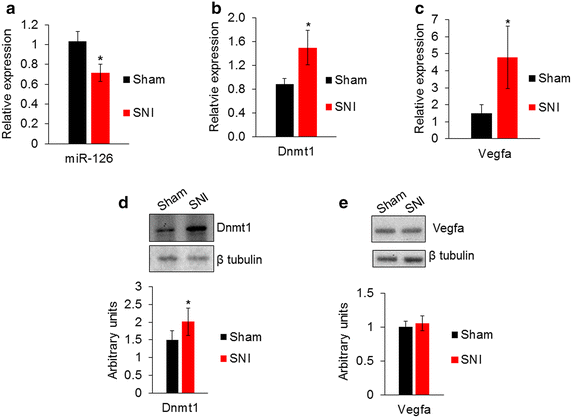
Researchers use our i-FectTM to effectively deliver miR-126 in vivo to modulate Methyl-CpG-binding protein 2 (MeCP2).

MeCP2 regulates gene expression through activation, repression and chromatin remodeling. Mutations in MeCP2 cause Rett syndrome, and these patients display impaired nociception. The researchers observed an increase in MeCP2 expression in mouse dorsal root ganglia (DRG) after peripheral nerve injury: Melissa T. Manners, Adam Ertel, Yuzhen Tian and Seena K. Ajit. Genome-wide redistribution of MeCP2 in dorsal root ganglia after peripheral nerve injury. Epigenetics & Chromatin 20169:23. DOI: 10.1186/s13072-016-0073-5© The Author(s) 2016 Received: 11 March 2016. Accepted: 27 May 2016Published: 7 June 2016...miRNA administration protocol was adapted from previous report of intrathecal miRNA delivery. To administer miRNA mimics, a polyurethane catheter (25G, 5.5 cm long, SAI infusion) was placed into the intrathecal space of the lumber L4–L5 vertebrae under isoflurane anesthesia. The catheter was stereotactically secured under the skin and occluded between injections. A custom miRCURY (Exiqon) miR-126 mimic containing a 5′ cholesterol tag and 3′ fluorescein label was injected at 2 nmol concentration with 4 µl iFECT transfection reagent (Neuromics). A total of 6 µl was delivered into the catheter connection juncture using a 25G blunt end needle on a Hamilton syringe. The catheter was then flushed with 7 µl sterile PBS to ensure miRNA reached the intrathecal space...

Figure: Expression of miR-126 and its target genes Dnmt1 and Vegfa in the DRG after nerve injury. a Relative expression of miR-126 determined by qPCR shows a reduction in miR-126 in SNI model compared to DRG from sham control. U6 was used for normalization (n = 8 sham, n = 7 SNI). b Relative expression of Dnmt1 mRNA and c Vegfa transcripts showed an increase in the DRG after nerve injury compared to control (n = 3). Gapdh was used as a normalizer. d Representative Western blot and quantification showed an increase of Dnmt1 protein in the DRG after nerve injury. e Western blot and quantification showed Vegfa protein was not significantly different in DRG after nerve injury (n = 3 from pooled samples, three DRG were pooled for each sample).


Conclusions: The study shows a regulatory role for MeCP2 in that changes in global redistribution can result in direct and indirect modulation of gene expression in the DRG. Alterations in genome-wide binding of MeCP2 therefore provide a molecular basis for a better understanding of epigenetic regulation-induced molecular changes underlying nerve injury.

Saturday, February 21, 2015

i-Fect Delivers siRNA in vitro and in vivo

Gene Expression Analysis for Studying Stroke

We have posted over 35 publications that reference use of our i-Fect Transfection Kit to deliver siRNA, miRNA and shRNA in vitro and in vivo. Results documented in these publications prove that this kit is both non-toxic and delivers ultra-high transfection efficiency.

i-Fect Data Example


Figure. The effects of HDAC2 siRNA Infusion into the CeA of P rats on voluntary ethanol consumption as measured by the two-bottle free choice paradigm. Monitoring the voluntary ethanol consumption of alcohol-preferring (P) rats via the two bottle free choice paradigm following infusion of vehicle or histone deacetylase isoform 2 (HDAC2) siRNA into the central amygdala (CeA) demonstrates that high HDAC2 levels may mediate the high alcohol drinking behaviors of P rats. P rats were given access to water and 7% ethanol followed by water and 9% ethanol. On the sixth day of ethanol access P rats received infusion of vehicle or HDAC2 siRNA and consumption of water and 9% ethanol were monitored for sevnfusion. Total fluid intake did not significantly differ between the groups. Values are represented as the mean ± SEM of the ethanol consumption (g / kg / day) and total fluid intake (mL) plotted daily for n=6 rats per treatment group. *Significantly different between the groups.SACHIN MOONAT. The Role of Amygdaloid Chromatin and Synaptic Remodeling in Anxiety and Alcoholism. THESIS Submitted as partial fulfillment of the requirements for the degree of Doctor of Philosophy in Neuroscience in the Graduate College of the University of Illinois at Chicago, 2014.

Here's yet another recent publication highlighting use of i-Fect:

In this study data suggest the protective effects of EPO on NUV injuries are highly associated with the increase of p-Cx43, which improves GJIC to reduce neurotoxic substances: Ziyi Zhoua, Xiaobai Weib, Jun Xiang, Junpeng Gao, Lixin Wang, Jinsong You, Yefeng Cai , Dingfang Caid. Protection of erythropoietin against ischemic neurovascular unit injuries through the effects of connexin43. Biochemical and Biophysical Research Communications. doi:10.1016/j.bbrc.2015.02...The strands were incubated at 90°C for 5 min and then at 37°C for 1 h. SiRNA was prepared immediately before administration by mixing the RNA solution (1 μg/μl in annealing buffer) with the transfection reagent i-Fect (v/v: 1/3; Neuromics, Edina, MN, USA) to a final siRNA ...

Highlights
•EPO has protective effects on ischemic NVU injuries.
•EPO up-regulates phosphorylation of Cx43, not total Cx43.
•EPO's protective effects on NUV injuries are p-Cx43-GJIC dependent.

Saturday, March 16, 2013

i-Fect™ Delivers Your siRNA Payload

Delivering siRNA to Dorsal Root Ganglia to Silence KV Receptors.

Our i-Fect transfection kits continue to be used to optimize delivery in vivo and into hard to transfect cells like primary neurons. In these 2 latest expamples, researchers use i-Fect to deliver siRNA to KV Receptors in Rat DRGs. Knocking down these receptors enable the study of their role in pain modulation: John H. Winston, Sushil K. Sarna. Developmental Origins of Functional Dyspepsia-Like Gastric Hypersensitivity in Rats. Gastroenterology. Volume 144, Issue 3, March 2013, Pages 570–579.e3. dx.doi.org/10.1053/j.gastro.2012.11.001....intrathecal treatment, 2 μg of the appropriate siRNA was mixed (1:5 vol/vol) with i-Fect transfection reagent (Neuromics, Edina, MN); rats received 2 ug siRNA/10 uL/rat/injection...

Figures. siRNA-mediated knockdown of Kv1.1 expression in thoracic DRG significantly increased gastric sensitivity in naive adult rats. (A) Western blots showed a significant decrease in Kv1.1 protein in thoracic DRG (T8–T12) after intrathecal treatment with Kv1.1 siRNA but not with control siRNA. siRNA treatment did not alter TrpV1 expression (n = 5 rats each; *P < .01 vs control siRNA). (B) Naive rats treated with Kv1.1 siRNA showed a significant increase in VMR to gastric distention (n = 5 rats each, compared with pretreatment baseline; *P < .05). (C) Treatment with control siRNA had no significant effect on gastric hypersensitivity. (D) Patch clamp recordings from freshly dissociated gastric DRG neurons from FD-like and PND 10 saline-treated littermate controls showed a significant decrease in rheobase in FD-like rats (*P < .05), and (E) a significant increase in the number of action potentials elicited by current injection at 3× the rheobase in gastric DRG neurons from FD-like rats (*P < .05). (F) Sample voltage vs time traces showing action potentials evoked at ×1, ×2, and ×3 rheobase. The patch clamp data were obtained from 16 cells from 5 PND 10 saline control rats and 19 cells from 5 FD-like rats.
Tsantoulas C, Zhu L, Shaifta Y, Grist J, Ward JP, Raouf R, Michael GJ, McMahon SB. Sensory neuron downregulation of the Kv9.1 potassium channel subunit mediates neuropathic pain following nerve injury. J Neurosci. 2012 Nov 28;32(48):17502-13. doi: 10.1523/JNEUROSCI.3561-12.2012..."I'd just like to notify you about a recent paper from my team which utilised iFect for in vivo transfection of dorsal root ganglia." Dr. Christoforos Tsantoulas, University of Cambridge...i-Fect-siRNA-mediated knock-down of Kv9.1 in naive rats led to neuropathic pain behaviors...

These add to the many publications referencing use of i-Fect to deliver siRNA. Genes studied include:  DOR, hTERT, The β3 subunit of the Na+,K+-ATPase, rSNSR1, NTS1. NAV1.8, , RANK, Toll-Like Receptors, Kv Recptors, BDNF, Ret, TRPV1, Survivin, Flaviviruses, NOV, Troy β-arrestin, TRPV1 CAV1.2 TLR4 and ASIC.

Saturday, October 04, 2008

siRNA-mediated gene silencing

Dr. Josephine Lai (Professor of Pharmacology, University of Arizona) is a pioneer in developing experimental designs and methods for delivering siRNA to the CNS for gene expression analysis.

She and her team have documented these in the publication:

For researchers desiring to effectively deliver siRNA to the CNS for gene expression of analysis of specific receptors, this publication offers proven methods. These include:

  • The Choice of siRNA
  • Choosing and Optimizing Transfection Reagents for siRNA Delivery to the Nervous System
  • Delivery Systems-Microinjection and Infusion (using mini-osmotic pumps)
  • Validation

We will continue to track advances by Dr. Lai and team